



Find a Lawyer
Book an appointment with us, or search the directory to find the right lawyer for you directly through the app.
Find out more


Al Adalla
Read MoreA complete spectrum of legal services across jurisdictions in the Middle East & North Africa.


Private Wealth Meets Flexible Capital: What Is A VCC?
 3 min 41 sec
Written by

 i.szadkowska@tamimi.com
  View LinkedIn Profile


In February 2026, the Dubai International Financial Centre (DIFC) enacted regulations introducing a new type of corporate structure, known as a variable capital company (VCC). Whilst similar vehicles have been in existence in some other jurisdictions, it is the first entity of its type available in the region.
What is a VCC?
A VCC is a company that could be formed in the DIFC. It can be formed as a private company and exist in a similar way to any other DIFC company. However, it is a unique type of a company, for the following reasons.
Share capital
The VCC’s share capital is equal to its net asset value (NAV), providing flexibility for the issuance and redemption of shares and, therefore, efficient capital inflows and outflows. This contrasts with a standard DIFC company, whose share capital is based on its nominal share value, and whose capital reduction process requires shareholder approval, solvency statements, creditor notifications, etc.
Organisational structure
Once a VCC is formed, it can establish:
- Segregated cells: Internal ‘compartments’ within a single VCC that ringfence assets/liabilities from each cell, without creating separate legal persons (e., the VCC is one company with multiple protected ‘pools’); or
- Incorporated cells: Separate legal entities formed under the VCC umbrella, each with its own licence and articles of association, but with no parent/subsidiary relationship to the VCC or to the other incorporated cells, making them easier to spin out and/or redomicile independently.
With segregated cells or incorporated cells, a VCC can segregate assets/liabilities, accompanying investment strategies and, ultimately, risk profiles, as needed.
Distributions from a VCC can be made from its NAV-based capital, and not just from realised profits, as is the case for a nominal/fixed capital company.
The VCC can establish incorporated cells at only US$1,000 each, and the segregated cells at US$300 each, making them more cost-efficient than any other comparable vehicle available in the UAE.
Compliance requirements
To ensure compliance and corporate administrative interface between the VCC and the DIFC Registrar of Companies (ROC) is maintained, in most cases, a VCC is required to appoint a corporate services provider.
Utilising VCCs for family wealth management
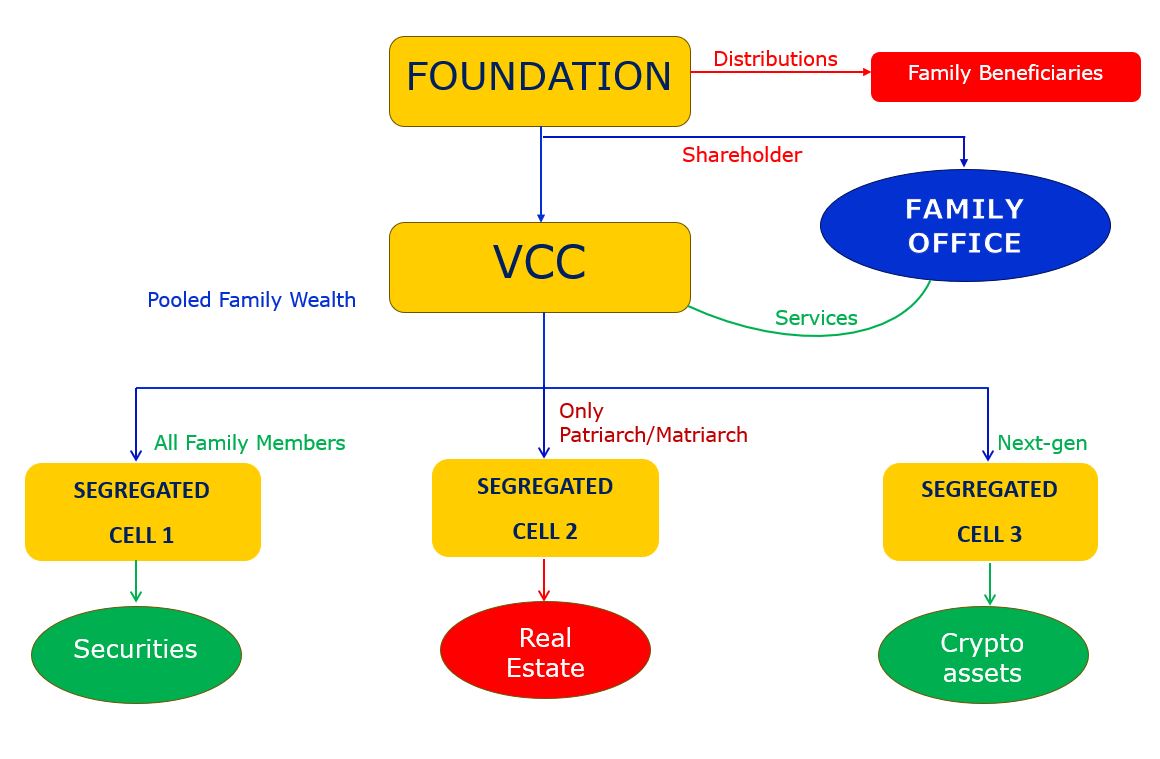
A VCC seems an ideal instrument for family wealth structuring, asset protection, and wealth preservation. The VCC could become an umbrella platform, providing centralised management and oversight of the family portfolio. Particular family members or branches could benefit from dedicated cells, shielding their own portfolios from liability that would attach to the cells of others.
The regulations provide families, family offices and other common private-wealth structures, such as trusts and foundations, the ability to house investment portfolios and asset classes with varying risk appetites under one overarching ‘platform’, without the need to be regulated as a fund or to incorporate successive holding companies.
Distributions could also be tailored towards specific beneficiaries, family branches, or individual members. Distributions from the ultimate private-wealth structure to family member beneficiaries could be correspondingly agreed in light of the VCC’s segregated holdings, if desired.
The VCC structure also supports portfolio risk management, as the liabilities of one cell (which, for example, may hold a riskier portfolio) would not taint that of another cell within the same VCC. These operative functions of a VCC combined with, for example, a DIFC foundation, would achieve not only the family’s investment goals, but also its succession planning and asset protection objectives.
To illustrate, we have set out below a sample family wealth preservation structure.
Conclusion
The VCC regulations represent a landmark development for private wealth structuring in the region, particularly in the context of family wealth structuring. The VCC regime offers families and family offices a sophisticated and cost-effective vehicle. It combines the asset protection strength of statutory ringfencing, the operational agility of NAV-linked capital, and the structural versatility of segregated or incorporated cells.
These benefits are all provided without the burden of regulatory authorisation for proprietary investment purposes. Whether deployed beneath a foundation for succession planning, used to segregate risk by a family office across family branches and generations, or structured to accommodate future spinouts and cross-border redomiciliation, the VCC provides a platform that can evolve alongside the family’s needs.
As the Gulf continues to cement its position as a global hub for private capital, we anticipate that the VCC will become a useful tool for advisers serving high net-worth families seeking stability, flexibility, and governance within the trusted common law framework of the DIFC.
Written by
Next Article