



Find a Lawyer
Book an appointment with us, or search the directory to find the right lawyer for you directly through the app.
Find out more


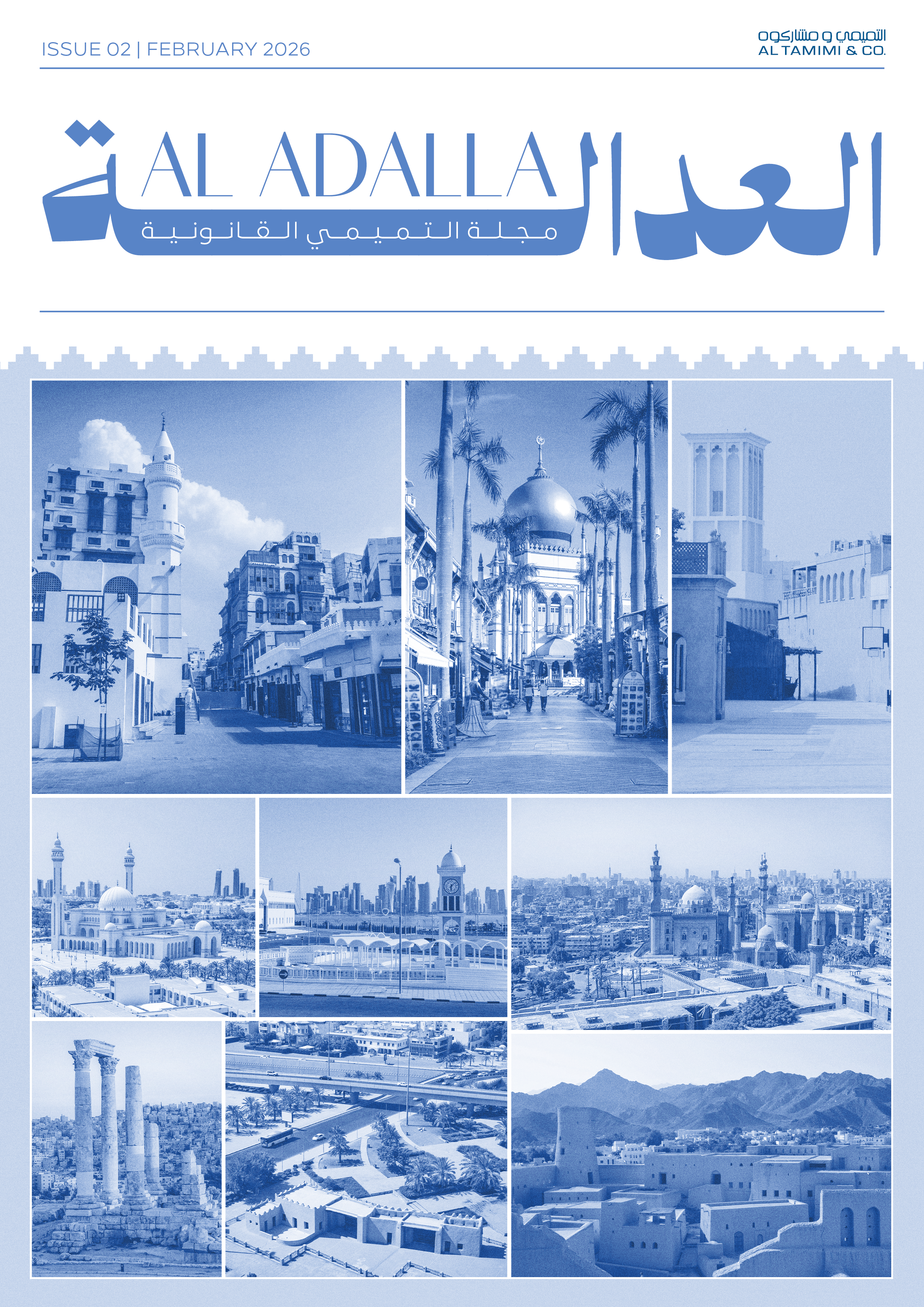
Al Adalla
Read MoreA complete spectrum of legal services across jurisdictions in the Middle East & North Africa.


Oman’s New Financial Frontier: Introducing the Oman International Financial Centre
The issuance of Royal Decree No. 8 of 2026 (“OIFC Law”) establishes the Oman International Financial Centre (the “OIFC”) as an independent, internationally oriented financial hub designed to anchor capital flows, deepen market sophistication and accelerate economic diversification in Oman. The OIFC Law provides for strategic objectives for the OIFC: consolidating Oman’s position as a leading international financial centre, enhancing financial sector contribution to GDP, and attracting regional and international institutions to Oman. Madinat Al Irfan in Muscat has been designated as the OIFC’s seat. The framework provides the OIFC with legal personality, financial and administrative autonomy to each of the OIFC’s core authorities and also establishes a bespoke courts system with defined jurisdiction and enforcement mechanics. Together, these features position the OIFC to compete credibly among GCC financial free zones while remaining anchored in Oman’s public interest objectives.
A ring-fenced legal environment
The OIF Law effects a clear legislative carve-out: with specific exceptions, Omani legislation does not apply to the OIFC, its authorities, its establishments or activities conducted within or through it, unless a specific law or Royal Decree provides otherwise. Within the OIFC, the following Omani enactments continue to apply: the Penal Code, Criminal Procedure Law, Income Tax Law, Excise Tax Law, Value Added Tax Law, Personal Income Tax Law, Anti-Money Laundering and Combating Terrorism Financing Law, Cybercrime Law and all legislation relating to national security and states of emergency. This ring-fenced model is akin to regional comparators such as the DIFC, the ADGM, and the QFC. At present, the “OIFC Rules” (laws, Royal Decrees, and regulations issued by the His Highness The Sultan that apply specifically to the OIFC, its authorities, its establishments, or the activities and services carried out within the OFIC) and “OIFC Regulations” (regulations, resolutions, bylaws, and orders regulating the OIFC Authorities or activities within the OIFC, issued by the board of directors of the OIFC (“Board”)) have not yet been issued, but the OIFC Law contemplates a build-out of legislation over the coming years. For the purposes of this article, OIFC Rules and OIFC Regulations are collectively referred to as “OIFC Legislation”.
Setting up in the OIFC
The OIFC Law recognizes “OIFC Establishments” as entities registered, licensed, or authorized to operate within the OIFC, including those carrying on regulated Financial Services or Ancillary Services. “Financial Services” expressly include banking, Islamic banking, insurance, investment and asset management, investment funds, capital markets, brokerage, and related advisory services, with further scope to be defined by OIFC Legislation. “Ancillary Services” include services, businesses, professions, and activities classified as ancillary to Financial Services and licensed accordingly, enabling professional services, technology, and market infrastructure providers to support core financial intermediation. No profession, business, or activity may be conducted within or through the OIFC without a license, permit, or approval from the competent OIFC authority, and registrations occur in accordance with OIFC Legislation and any Omani legislation in force within the OIFC. OIFC Establishments must conduct activities strictly per their authorizations; activities outside the OIFC’s geographic boundaries default to Omani legislation, with a targeted exception for OIFC Establishments conducting marketing, offering, and related advisory activities in Oman that remain governed by OIFC rules. Contracts and transactions arising from such extra-territorial promotional and offering activities are deemed concluded within the OIFC and are exclusively subject to OIFC legislation, reinforcing legal certainty for cross-border and outreach engagements.
The Three Authorities: Mandates and Core Competencies
The “OIFC Authorities” currently comprises three principal authorities, each with legal personality and operational autonomy:
- The “OIFC Authority”leads strategy, infrastructure, establishment registration, intra-governmental coordination, data governance, and international promotion, and may furnish administrative support while preserving the independence of peer authorities. Its board drives legislative proposals (excluding peers’ reserved domains), issues applicable rules, manages budgets, structures, and assets, and can establish representative offices abroad.
- The “OIFC Regulatory Authority”regulates Financial Services and Ancillary Services, registers OIFC Establishments, and serves as the supervisory authority for AML/CFT across all OIFC Establishments and relevant non-financial businesses and professions. Its board may propose OIFC Legislation in its remit, consult publicly, set licensing scope for regulated activities and manage its institutional and financial affairs.
- The “OIFC Dispute Resolution Authority”supports and safeguards judicial independence, builds ADR infrastructure, approves arbitration and mediation procedural rules, and manages budgets and operations for the dispute resolution ecosystem. The Chief Justice of the OIFC Courts chairs the OIFC Dispute Resolution Authority, ensuring integrated oversight between the tribunal function and its enabling administration.
Courts and enforcement: jurisdiction, finality, and recognition
The “OIFC Courts” comprise a Court of First Instance and a Court of Appeal, with potential for additional courts by Royal Decree. The OIFC Courts sit within the OIFC but may convene elsewhere as needed. Judges enjoy functional immunity absent fraud or bad faith, and the OIFC Courts are treated as Omani courts for jurisdictional purposes. Jurisdiction spans interpretation of OIFC Legislation, civil, commercial, and labour matters involving OIFC Authorities or OIFC Establishments, contracts connected to the OIFC, incidents occurring in whole or part within the OIFC, certain wills of non-Muslims, arbitration matters tied to the OIFC, and any other matters granted to it by the OIFC or Omani law or international treaties. Parties may also confer jurisdiction of the OIFC expressly in writing.
Appeals lie to the Court of Appeal, which may exceptionally act as a court of first instance on direction of the Chief Justice for matters of justice or interpretation. Its judgments are final and unappealable. Enforcement is streamlined: OIFC Courts enforce their judgments and recognized awards and may coordinate with Omani courts to undertake enforcement actions without merits review by external enforcement judges. Conversely, Omani court judgments and ratified awards can be enforced through the OIFC Courts, again without re-opening the merits, applying OIFC enforcement procedures. Foreign and extra-OIFC awards may be enforced within the OIFC upon recognition or ratification under OIFC Legislation.
Tax: long-horizon exemptions and Special Zone treatment
For up to 50 years from entry into force, the OIFC offers a suite of tax exemptions, with the Minister of Finance empowered to grant additional benefits under tax regulations that define qualifying activities and detailed implementation. Exemptions include, among others: income of OIFC Establishments from qualifying activities, specified cross-border payments and returns (including royalties, R&D remuneration, software payments, management/service fees, dividends, and interest) derived by non-resident legal persons from transactions with OIFC Authorities or OIFC Establishments, and certain income of non-Omani natural persons connected to the OIFC, including from non-Omani sources as defined in the regulations. For VAT, the OIFC is treated as a Special Zone for exempt and zero-rated supplies. Asset protections complement the fiscal regime by insulating OIFC Establishments and covered employees’ assets from nationalization and similar measures, save for tax debt collection via administrative execution.
Onshore interfaces and residency
The OIFC Law enables Omani-regulated companies and institutions to establish headquarters within the OIFC under Board-set conditions, with Omani legislation continuing to apply to them. These entities can also undertake OIFC-regulated Financial Services or Ancillary Services upon obtaining the requisite OIFC licenses. Non-financial or non-commercial activities by such entities are governed by contract with the OIFC Authorities, clarifying rights and obligations. The OIFC Law also mandates a branch of the Directorate General of Passports and Civil Status within the OIFC to issue entry visas and resident cards for non-Omani persons subject to the law, plus spouses and first-degree relatives, streamlining mobility. The OIFC Law also provides that residency in Oman shall be granted to non-Omani persons subject to the OIFC Law, non-Omani owners of OIFC real estate units, and non-Omani employees in the OIFC, including their spouses and first-degree relatives, per Board-approved conditions coordinated with the Royal Oman Police.
Conclusion
The OIFC Law lays the foundation for a sophisticated, ring-fenced financial ecosystem in Oman, combining independent regulation, specialized courts and long-dated tax incentives to attract regional and global institutions to Oman. As OIFC Legislation is issued and developed over the next several years, the OIFC is poised to develop a comprehensive regulatory canon comparable to leading GCC financial centers. Early movers that align their structures, governance and licensing strategies with the OIFC framework will be well-placed to capture opportunities in capital markets, asset management, banking, insurance, fintech, and the broader services stack that underpins them. We are prepared to guide clients through each stage-from initial feasibility to licensing, operationalization and dispute resolution-to realize the potential of the OIFC.
How we can assist clients going forward
Launching operations in the OIFC will require careful sequencing across corporate structuring, regulatory engagement and tax planning. We can support clients end-to-end by mapping business models to the OIFC’s licensing perimeter, preparing applications for Financial Services and Ancillary Services and coordinating pre-filing engagement with the OIFC Regulatory Authority to calibrate scope, controllers, fitness and propriety and prudential or conduct expectations. We also advise on group structuring to align onshore and OIFC footprints, including the use of holding companies, branches, funds and special purpose vehicles, while addressing extra-territorial marketing and offering activities governed by OIFC Legislation.
From a policy and governance perspective, we can help clients interpret OIFC Legislation, participate in consultations and embed internal policies across AML/CFT, risk, compliance, outsourcing, data, and operational resilience that reflect OIFC rules and the limited set of mandatorily applicable Omani laws. We will be able to advise on disputes and coordinate recognition and enforcement in Oman where needed. For talent mobility and real estate, we can also advise on residency pathways and on acquisition or leasing of OIFC units.
 s.puri@tamimi.com
Spread the news


Stay updated
To learn more about our services and get the latest legal insights from across the Middle East and North Africa region, click on the link below.