



Find a Lawyer
Book an appointment with us, or search the directory to find the right lawyer for you directly through the app.
Find out more


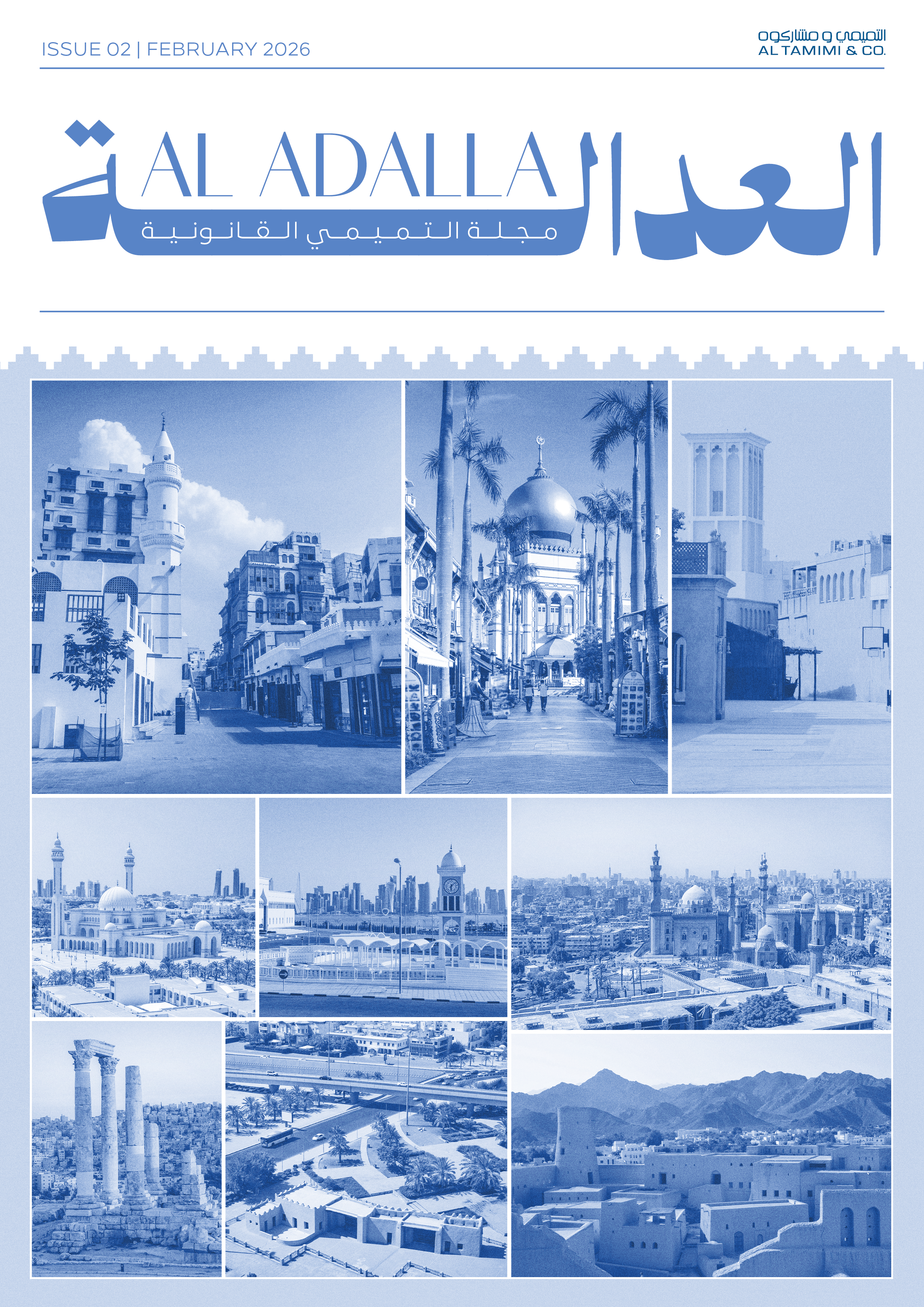
Al Adalla
Read MoreA complete spectrum of legal services across jurisdictions in the Middle East & North Africa.


Pharmaceuticals & IP Protection in the GCC: Transitioning Towards a Stronger Economy
 5 min 5 sec
February 6, 2026 (Edited)
5 min 5 sec
February 6, 2026 (Edited)
Written by

Ahmad Saleh
Partner, Head of Innovation, Patents & Industrial Property
 ah.saleh@tamimi.com
 View LinkedIn Profile

The Gulf Cooperation Council (GCC) region has increasingly positioned healthcare and life sciences at the centre of its economic diversification and national development agendas. Governments across the region are channeling substantial investment into advanced healthcare infrastructure, research institutions, and biotechnology ecosystems. Consequently, the strength and predictability of intellectual property (IP) protection in pharmaceutical and other healthcare sectors has emerged as a pivotal driver of innovation, foreign investment, and sustainable access to medicine.
In recent years, the GCC has made notable progress in modernising IP and regulatory frameworks, with the United Arab Emirates (UAE) and the Kingdom of Saudi Arabia (KSA) playing especially prominent roles. New mechanisms have been introduced to promote innovation, incentivise originator investments, and structure market entry. While these developments represent meaningful progress, there is room for further progress to continue strengthening the life sciences industry across the region.
Regulatory data protection as a complement to patent rights
There is a growing consensus across the GCC that regulatory data protection (RDP) and data exclusivity operate as essential complements to patent rights. Data exclusivity protects the undisclosed clinical and pre-clinical data submitted for marketing approval by preventing subsequent applicants — most notably generics and biosimilars — from relying on that data for a defined period. This protection is particularly critical for biologics, complex therapies, and advanced modalities, where patent scope or enforceability may not fully secure effective market exclusivity.
“For biologics and complex therapies, data exclusivity is as commercially significant as patents.”
Reflecting this shift, jurisdictions such as the UAE and Saudi Arabia have taken concrete steps to formalise and strengthen data exclusivity and related regulatory protections. These measures implicitly recognise the immense scientific, economic, and ethical investment required to generate robust clinical evidence and the need to calibrate incentives for sustained innovation.
In the UAE, Ministerial Decree No. 321 of 2020 (Decree 321) introduced a defined eight-year data exclusivity period for innovative pharmaceutical products, calculated from the date of marketing approval. This provides significant regulatory protection beyond patent rights and effectively aligns the UAE with international best practice.
Importantly, Decree 321 also enables generic manufacturers to file for marketing authorisation up to two years before the expiry of the exclusivity period, subject to demonstrating the absence of valid patent protection in the UAE. This structure aims to balance innovation incentives with regulatory predictability, facilitating market preparedness without compromising the core exclusivity period.
“The UAE’s data exclusivity framework reflects a deliberate attempt to balance innovation incentives with market preparedness and transparency.”
In the KSA, core data exclusivity protections remain anchored in the Regulations for the Protection of Confidential Commercial Information. The regulatory ecosystem, however, has evolved through the implementation of patent linkage mechanisms since January 2023. Patent linkage allows pharmaceutical companies to list their patents in connection with their innovation products before the Saudi Food and Drug Authority.
This ties the regulatory approval process to the status of the relevant patent, reinforcing practical exclusivity by preventing regulatory clearance of generics while patents remain valid. While standalone data exclusivity periods are generally five years under confidentiality rules, the linkage regime has become a powerful tool for aligning regulatory outcomes with IP status and improving the predictability of market entry.
“The KSA’s patent linkage framework has emerged as an important enforcement lever, reinforcing effective market exclusivity by preventing regulatory approval of generic products in circumstances where valid patent protection remains in force.”
Notwithstanding these advancements, data exclusivity frameworks across the GCC remain uneven. The scope of protection, duration of exclusivity, eligibility criteria, and enforcement mechanisms vary considerably between GCC member states. This lack of harmonisation introduces uncertainty for originators and complicates regional launch sequencing, lifecycle strategies, and cross-border regulatory planning. The absence of explicit patent linkage systems in many GCC states further fragments the interface between patent rights, marketing authorisation, and generic entry. As a result, innovators must navigate a patchwork of patent and regulatory pathways, often on a country-by-country basis.
Second medical use claims: Legal silence, restrictive practice
One of the most persistent legal gaps in GCC pharmaceutical patent law relates to the acceptance of second medical use claims. As R&D increasingly targets new indications, dosing regimens, formulations, and patient sub-populations for known molecules, protecting such downstream innovation has become commercially pivotal.
Across much of the GCC, statutory frameworks are either silent or ambiguous concerning second medical use claims. In practice, patent office’s often adopt a restrictive approach, rejecting these claims as impermissible methods of medical treatment — even where the legislative text does not explicitly mandate such an outcome.
The absence of detailed examination guidelines further fuels uncertainty and inconsistent results across jurisdictions. Some countries, such as the KSA, are clearly leaning towards the rejection of second medical use claims. The KSA’s new patent law and regulations (which are expected to be published in the near future) are expected to expressly prohibit patent protection of such claims in the Kingdom.
“In many countries in the GCC, the challenge is not legislative prohibition but administrative caution.”
This disconnects between the statutory baseline and administrative practice constrains lifecycle management and requires heavier reliance on non-patent mechanisms, such as data exclusivity or regulatory pathways, to secure a viable period of market differentiation.
Structural enforcement gaps and judicial capacity
Beyond questions of patentability, enforcement capacity remains uneven across the region. Specialised IP courts, judicial expertise in complex life sciences disputes, and access to effective interim remedies — such as preliminary injunctions and border measures — are not uniformly available.
Where enforcement mechanisms exist, procedural timelines, evidentiary thresholds, and coordination between courts and regulators can vary significantly. These variations affect litigation risk assessments, cross-border enforcement strategies, settlement negotiations, and licensing leverage. Even where rights are formally granted, the lack of consistent enforcement across the GCC countries may diminish commercial predictability and can distort investment decisions.
A fragmented regional landscape
While the UAE and Saudi Arabia have advanced reforms, other GCC jurisdictions — including Bahrain, Kuwait, Oman, and Qatar — are progressing at different speeds. Divergences in patentability standards, data protection regimes, regulatory transparency, and administrative practice contribute to a regional patchwork. This fragmentation complicates filing strategies, portfolio optimisation, pricing and reimbursement planning, and coordinated enforcement across multiple national markets.
Written by
Ahmad Saleh
Partner, Head of Innovation, Patents & Industrial Property
ah.saleh@tamimi.com
View LinkedIn Profile
Today, the region stands at an inflection point. If the GCC strengths and aligns its frameworks on data exclusivity, strengthens and clarifies patentability for downstream innovation, and ensures credible, timely enforcement, it will not only attract manufacturing, but also anchor foreign direct investment in R&D, discovery, development, and commercialisation. If it does not, capital and clinical evidence will migrate to jurisdictions where legal signals are clearer and enforcement is steadier.
Conclusion: From momentum to market leadership
The GCC has laid the groundwork for an innovation-forward life sciences ecosystem. The trajectory is unmistakable: stronger data exclusivity in the UAE, a meaningful patent linkage regime in the KSA, and a heightened policy focus on healthcare and biotechnology across the region.
The next stage requires further advancements in patent and data exclusivity regimes to further boost pharma and healthcare innovation-related industries. These gains should be consolidated through calibrated harmonisation, enhanced flexibility, or clearer guidance on the patent eligibility of certain types of innovations (such as second medical use claims) and strengthened judicial and regulatory capacity. A more consistent regional approach — paired with robust public health safeguards — would unlock faster innovation cycles, higher-value clinical research, and improved patient access.
Today, the region stands at an inflection point. If the GCC aligns its frameworks on data exclusivity, clarifies patentability for downstream innovation, and ensures credible, timely enforcement, it will not only attract manufacturing, but also anchor investment in R&D, discovery, development, and commercialisation. If it does not, capital and clinical evidence will migrate to jurisdictions where legal signals are clearer and enforcement is steadier.
The question is no longer whether the GCC can build a modern life sciences system. It has. The question is whether it will seize the mantle of global competitiveness by turning regulatory momentum into durable advantage — transforming the region from a market where innovation arrives into a market where innovation is born.
Next Article